Saturday, 30 April 2016

The Black Market in Wartime Britain

The black market became very much a part of wartime life. With rationing, and rising prices, it held a certain appeal. This was even the case by the end of the war when people were sick of austerity and shortages. ‘Wide boys’, ‘Spivs’, or ‘Wheelers and Dealers’, as they were known, were very clever at flaunting authority and ignored the fact what they were involved in was illegal. They were making money, so why would they not be prepared to take the risk? These fellows had a certain style about them, often quite flashily dressed in a wide-lapelled suit and brightly coloured tie, sporting a trilby hat tilted rakishly over his forehead.

Surplus goods would fall into their hands out of clever conniving and trickery, which they’d sell on at a price. One of the characters in this book: Home is Where the Heart Is gets involved. On one occasion he arranges for a driver to leave his cab door open so that he can help himself to some goods left on the passenger seat. Did he get away with it? You’ll have to read the book to find out more.

Shopkeepers would hide stuff under the counter for registered customers who were special to them. Salmon and peaches were often supplied in that way. Where they got these products from was never asked about. This was considered to be a good way of holding on to their best customers.

Black market goods were often more expensive, although their quality not always reliable. As well as food these might include petrol, spare parts for a car, cigarettes and alcohol. Cosmetics, perfume and nylons were also hard to come by during the war, even though women were encouraged to look their best for purposes of morale. This created sales of the kind of cosmetics that were not necessarily safe.

The Ministry of Food would investigate any complaints brought by the public of those suspected of being black marketers. They could be fined, or even imprisoned. But more often than not they got away with it because people would avoid informing the authorities. The believed it was not their concern and they’d lose out if the black market disappeared. The government fought something of a losing battle with those involved in the black market, despite employing hundreds of inspectors to enforce the law.


1945: Christmas is approaching and Cathie Morgan is awaiting the return of her beloved fiancĂ©, Alexander Ramsay. But she has a secret that she’s anxious to share with him. One that could change everything between them. 

Her sister has died and she wants to adopt her son. When the truth is finally revealed, Alex immediately calls off the wedding, claiming that the baby is actually Cathie’s, causing all of Cathie’s fears to be realised. As Cathie battles to reassure Alex of her fidelity, she must also juggle the care of the baby and their home. 

But then Alex crosses the line with a deceit that is unforgivable, leaving Cathie to muster the courage to forge a life for her and her nephew alone. Will Cathie ever be able to trust another man again and as peace begins to settle will she ever be able to call a house a home… 

Available from most book stores, WH Smiths and as ebooks.
   
Amazon
  

Kobo


Friday, 8 April 2016

Where Dragonflies Hover publication day!

Where Dragonflies Hover is released today! Yay!
I really enjoyed writing this story. It's the first time I wrote a split-era novel (modern/1915).
I think having two strong heroines worked in this case. From the diary she finds, Lexi learns a lot of about life and love from Allie, the diarist.
WWI is an interest of mine. The first World War was a time of change in so many ways. Allie as a nurse experiences first hand the effects of what a tragic and perilous time it was. The biggest thing she learns, however, is that life is short, we never know when our time is up, so make the most of it. I totally agree with that lesson, and it is one that Lexi learns, too.

I hope you enjoy reading Where Dragonflies Hover as much as I did writing it.
AnneMarie Brear


Where Dragonflies Hover blurb:

Sometimes a glimpse into the past can help make sense of the future …

Everyone thinks Lexi is crazy when she falls in love with Hollingsworth House – a crumbling old Georgian mansion in Yorkshire – and nobody more so than her husband, Dylan. But there’s something very special about the place, and Lexi can sense it. 
Whilst exploring the grounds she stumbles across an old diary and, within its pages, she meets Allie – an Australian nurse working in France during the First World War.
Lexi finally realises her dream of buying Hollingsworth but her obsession with the house leaves her marriage in tatters. In the lonely nights that follow, Allie’s diary becomes Lexi’s companion, comforting her in moments of darkness and pain. And as Lexi reads, the nurse’s scandalous connection to the house is revealed …

 
Excerpt:

The late sunshine enveloped the house in a golden glow. Again, it seemed to call to her, begging for attention. A path on the left of the drive looked inviting as it meandered through a small strand of poplars. Lexi grabbed her keys, locked the car and took off to explore again. She had nothing to rush home to now, and if she got caught for trespassing, then so be it.
The overgrown pathway brought her out on the far side of the grounds near the end of a small lake. She gazed over the water towards the back of the house and noticed a paved terrace area. From there the lawn then sloped down to the water. She’d not been around the back before and fell even more in love with the property. She could imagine the serenity of sipping a cool drink on a hot summer’s day and looking out over the lake.
Lexi stepped out along the bank. A lone duck swam by, its movement serene on the glassy, dark surface. This side of the lake was in shadow from large pine trees, and she stumbled on fallen pinecones hidden in the long grass. On the opposite side of the water were some small buildings, a garage, fruit trees in early blossom, and an overgrown vegetable patch, complete with a broken, rejected-looking scarecrow.
She wandered over to a narrow shed on her left and peered through its sole, dirty window. Unable to make out much in the dimness, she walked around to the front and was surprised when she was able to pull the bolt back on the door. Why didn’t people lock things? A covered rowboat took up most of the space inside. She smiled, seeing herself rowing it on the lake. Growing more excited, Lexi edged around it to peer at the workbenches and the odd assortment of tools and useless things one found in abandoned sheds. It was like treasure hunting in an antique shop. She used to love doing that with her grandfather.
She glanced about and spied a dusty painting leaning against the wall. The scene was of a child and a brown dog. Behind the canvas were more paintings, some framed, some not. Lexi flicked through them. The ones that caught her attention she took out and set aside.
She looked for somewhere to sit and study the paintings. A small tin trunk wedged under a workbench seemed the only offering. Thinking it empty, she went to tug it out, but it remained fast.
Using both hands, she heaved it out and was showered in a puff of dust. Squatting down, she inspected the latch that was held tight with a small lock. ‘Why are you locked?’ she murmured. The shed was open to anyone passing by, yet this ugly little chest had a lock on it. The trunk was nothing special, plain and in parts rusted. No ornament or writing hinted at its use.
Intrigued, she grabbed a hammer from the workbench, but then hesitated. She had no right to open someone else’s property. Lexi closed her eyes momentarily. What was she thinking of breaking into the trunk? What am I doing? Never had she broken the law and here she was guilty of trespassing and breaking and entering! She looked around the rowboat as though expecting someone to jump out and arrest her.
Something inside urged her on. She knew she couldn’t stop now. Sucking in a deep breath, she bent and hit the lock hard. The ringing sound was loud in the quiet serenity of the garden. The metal dented and with another few solid whacks the lock gave.
Shivers of excitement tingled along her skin. Gently, she eased up the lid.

 Buy links:


Also available in Apple ibooks, etc.

Wednesday, 30 March 2016

Inspiration for the Polly books


The idea came from the story of Great Aunt Hannah who, back in the thirties, in order to survive through difficult times, sold off all their furniture save for an earthenware bread bin and their bed. The bread bin thereafter held their food, and acted as a table or stool. With the money, she and her husband bought second hand carpets from auctions and better class homes, which they cut up to sell on the local market. They also bought many other items offered, such as small pictures, clocks, jugs and vases, even chamber pots. Anything saleable was grist to the mill for them to survive. Everything would be loaded on to a two-wheeled hand cart and transported home to their rented terraced house.

Carpets in those days were a luxury, most houses in working class areas covering their floors with lino, although kitchens were generally just scrubbed flags, perhaps with a rag rug made from scraps of old clothes. But when they first went into business they did not have the space or the facilities to properly clean the carpets before putting them up for sale. On one occasion Aunt Hannah was showing a carpet to a prospective buyer when a huge cockroach ran across it. Fortunately he didn’t see it as she quickly grabbed the horrible thing in her hand and held it until the customer had paid for the carpet and left. She must have been a tough lady.

They also bought the entire set of carpets from the German ship SS Leviathan which was being scrapped. In order to do that, and having refurnished from the profit made, they sold everything all over again, repeating this process several times. Gradually their hard work paid off and they expanded, renting the shop next door, and later bought property where they began to sell new carpets, as Polly does in the books.

Aunt Hannah was such a kind lady that when my parents, who had married early in the war, finally set up home together in 1945 in rented premises as a shoe repairer, living behind the shop, she gave them a brand new carpet as a gift. They treasured this for much of their married life, as they only had Dad’s demob money, and otherwise would have been on bare boards.

I often use family stories, suitably adapted and fictionalised. In this case my aunt had a very happy marriage, not suffering the traumas that Polly was forced to endure.


Polly Pride feels luckier than most who live in the poor Ancoats area of Manchester. She has a loving husband, two healthy children, a place of their own and a regular wage coming in. But it is the late 1920s, unrest is in the air, employers are putting on the squeeze, and when Matthew loses his job Polly’s life is thrown into turmoil. 

With no money coming in Polly decides that only drastic action can keep the family from starvation and in a desperate gamble she sells all the family goods and chattels and buys a handcart, from which she sells second-hand rugs and carpets. But struggling to deal with poverty and her husband’s hurt pride are only the start of her problems, for when tragedy strikes Polly has to do battle with the bigotry of a sour brother-in-law to keep herself and her family from falling apart.  


Reviews

‘Polly is made of stern stuff. . . the tale of her courage and grit against the backdrop of a Northern city in the grip of depression makes for a powerful narrative.’ Newcastle Evening Chronicle on Polly's Pride

'A heart-warming saga of a woman overcoming obstacles in the face of adversity with a triumphant finish.' Bradford Telegraph & Argus on Polly's Pride


Polly's Pride - Amazon UK

Polly's War - Amazon UK

Thursday, 17 March 2016

Cover Reveal: Where Dragonflies Hover

My latest release, Where Dragonflies Hover, is a contemporary story that also features a WWI story, when Lexi, the main character finds a diary written by a wartime nurse.

Where Dragonflies Hover blurb:
Sometimes a glimpse into the past can help make sense of the future …
Everyone thinks Lexi is crazy when she falls in love with Hollingsworth House – a crumbling old Georgian mansion in Yorkshire – and nobody more so than her husband, Dylan. But there’s something very special about the place, and Lexi can sense it. 
Whilst exploring the grounds she stumbles across an old diary and, within its pages, she meets Allie – an Australian nurse working in France during the First World War.
Lexi finally realises her dream of buying Hollingsworth but her obsession with the house leaves her marriage in tatters. In the lonely nights that follow, Allie’s diary becomes Lexi’s companion, comforting her in moments of darkness and pain. And as Lexi reads, the nurse’s scandalous connection to the house is revealed …


Excerpt:
The late sunshine enveloped the house in a golden glow. Again, it seemed to call to her, begging for attention. A path on the left of the drive looked inviting as it meandered through a small strand of poplars. Lexi grabbed her keys, locked the car and took off to explore again. She had nothing to rush home to now, and if she got caught for trespassing, then so be it.
The overgrown pathway brought her out on the far side of the grounds near the end of a small lake. She gazed over the water towards the back of the house and noticed a paved terrace area. From there the lawn then sloped down to the water. She’d not been around the back before and fell even more in love with the property. She could imagine the serenity of sipping a cool drink on a hot summer’s day and looking out over the lake.
Lexi stepped out along the bank. A lone duck swam by, its movement serene on the glassy, dark surface. This side of the lake was in shadow from large pine trees, and she stumbled on fallen pinecones hidden in the long grass. On the opposite side of the water were some small buildings, a garage, fruit trees in early blossom, and an overgrown vegetable patch, complete with a broken, rejected-looking scarecrow.
She wandered over to a narrow shed on her left and peered through its sole, dirty window. Unable to make out much in the dimness, she walked around to the front and was surprised when she was able to pull the bolt back on the door. Why didn’t people lock things? A covered rowboat took up most of the space inside. She smiled, seeing herself rowing it on the lake. Growing more excited, Lexi edged around it to peer at the workbenches and the odd assortment of tools and useless things one found in abandoned sheds. It was like treasure hunting in an antique shop. She used to love doing that with her grandfather.
She glanced about and spied a dusty painting leaning against the wall. The scene was of a child and a brown dog. Behind the canvas were more paintings, some framed, some not. Lexi flicked through them. The ones that caught her attention she took out and set aside.
She looked for somewhere to sit and study the paintings. A small tin trunk wedged under a workbench seemed the only offering. Thinking it empty, she went to tug it out, but it remained fast.
Using both hands, she heaved it out and was showered in a puff of dust. Squatting down, she inspected the latch that was held tight with a small lock. ‘Why are you locked?’ she murmured. The shed was open to anyone passing by, yet this ugly little chest had a lock on it. The trunk was nothing special, plain and in parts rusted. No ornament or writing hinted at its use.
Intrigued, she grabbed a hammer from the workbench, but then hesitated. She had no right to open someone else’s property. Lexi closed her eyes momentarily. What was she thinking of breaking into the trunk? What am I doing? Never had she broken the law and here she was guilty of trespassing and breaking and entering! She looked around the rowboat as though expecting someone to jump out and arrest her.
Something inside urged her on. She knew she couldn’t stop now. Sucking in a deep breath, she bent and hit the lock hard. The ringing sound was loud in the quiet serenity of the garden. The metal dented and with another few solid whacks the lock gave.
Shivers of excitement tingled along her skin. Gently, she eased up the lid.

Buy links:

Also available in Apple ibooks, etc.

Wednesday, 2 March 2016

Historical saga: The Day Embroidered

The Day Embroidered


The Day Embroidered
blurb:
1899. A life altering event led Catrina Davies to hide from her family and society. Alone in The Highlands she exists in a lonely world cared for only by her saviour, a kind old gentleman. When she receives a surprise visitor, Travis Millard, the man she used to love, her head and heart are thrown into turmoil. 
Travis is determined to save her from this poor life and return her to her family where she belongs. No one is more surprised than he when she agrees to marry him. 
When Catrina arrives back at her family estate, Davmoor Court in Yorkshire, she is stunned to see the changes. While her father clings to life, Davmoor is nearly ruined by her brother's gambling obsession, and there is something strange about his new wife. 
As Catrina adjusts to her regained position in society and being with Travis, her marriage comes under attack from Travis's grandmother, who has her own secrets and reason for loathing the Davies family. 
When one of her brother's adversaries comes to stake his claim on the estate, the resulting chaos threatens not only Catrina's home, but the very lives of those she loves the most. 
Can she find the strength to fight once more for the right to be happy?

The Day Embroidered is available in paperback or ebook from all places such as Amazon USA and UK, etc.

Thursday, 18 February 2016

Historical Women's Fiction Sale.

My historical women's fiction book, To Gain What's Lost, is about to start a three day price reduction promotion on Amazon UK and Amazon USA.
It will be on sale for .99c starting Friday 20th until Monday morning.
Amazon UK
Amazon USA


Tuesday, 9 February 2016

R.I.P. Mary Nichols.

It is with sadness that I post the news we have lost a lovely member of our blog, Mary Nichols, who has passed away after an illness.
Mary was a wonderful woman and a great story teller. She wrote a great many books over her career. She will be missed.

Some of Mary's books, which are still available on Amazon.


Sunday, 3 January 2016

Happy New Year!

Well, it's 2016. What will this year bring? Can it match last year? Can it outdo 2015? It would be a hard task as 2015 was such a special year for me as I married such a wonderful man and we had a great year. I also visited three new countries - Mexico, Spain and America. I had a fascinating time at each place.
2015 also saw me resurrect my interest in writing novels and delving back into the writing industry. I decided to continue writing a novel I started back in 2011. I also signed a contract with a new publisher to release my novel, The Diary, which will be out this year.
Self publishing my novels on Amazon in paperback as well as ebook was an achievement I enjoyed creating.
So, in 2016, I am looking forward to publishing more stories, visiting new places and making new friends.
I wish everyone a safe and healthy 2016!

Monday, 21 December 2015

Google into the New Year!


Christmas  came early for me this year with the publication in October of my second in the Lizzie Flowers series, “The Fight for Lizzie Flowers”. The rewarding verdict from you guys was that you hadn't guessed the surprise opening! I had, actually, seen this scene in my mind long ago, so I won’t say more on Lizzie's adventures - not until book three! I’m also enjoying a sizzling December promotion with “Together for Christmas” at 99p both on Amazon and Kobo's shelves. Needless to say my virtual Christmas stocking is half-full even before the 25th!

Right now I’m working on the final edits of next year's book, a story I literally sat on the edge of my seat to write as my young East End heroine, Ruby Payne, teeters on the brink of disaster on almost every page! Without giving too much away, I can tell you that Ruby's precarious journey to find love, glamour and excitement sweeps her into London's West End and the tempting but shadowy world of 1950’s Soho. Ruby has some hard lessons to learn. And I can certainly relate to a few of them!

So whether you Google the greats via a screen, turn those delicious paper pages one by one, or listen to audio in a bubble-filled bath, I hope your literary escapism is choc-full of dynamic characters, pulverising plots and salubriously satisfying endings. (Whew!) I’ll be thinking of you over the holiday and look forward to chilling with you again soon. A very happy, healthy and prosperous New Year to you all. Love CarolR x

Sunday, 22 November 2015

Books in paperback!

Over the last few weeks I've been creating some of my books into paperbacks so they are available on Amazon for those people who don't have Kindles. I'm very pleased with the results. I wish I had done it ages ago, but they are done now and I hope readers feel they are worth it. 


Tuesday, 17 November 2015

Post-War Issues suffered by Women

When World War II ended there was a feeling of anti-climax, as if the bright blue, sun-filled sky had clouded over, leaving a feeling of uncertainty about the future. A grey chill seemed to hang over everything. But then the country was in a mess, near bankrupt. There were bombed areas and rubble everywhere, homes lost or wrecked, many empty shops and huge bomb craters everywhere.

Women had become much more hardened and independent, having worked hard jobs usually occupied by men, spending endless sleepless nights in shelters fearing they could be killed. And suffering years of anguish worrying over the fate of their loved ones in the war.

When the fighting men returned, these problems were not always taken into account, the husband too beset by his own problems. Women lost their jobs, expected to concentrate on being a wife and mother again by creating a family and home. Housework did take much more time in those days, of course. Even so, many of them resented this change in their lives. They were also urged to no longer wear plain looking suits, trousers or overalls, but to be bright and pretty females again.

She might also have to cope with a shell-shocked or injured husband, outbursts of violence, depression or infidelity. A soldier having been trained to kill was not always the same civilised a person he’d once been. He could be far too accustomed to giving orders and inflicting punishment in order to achieve his aim, for him to show much patience for her. Or he might feel in desperate need for peace and quiet and hardly move or speak.

Many men suffered from sleepwalking, nightmares, or shouting in their sleep. Settling back into Civvy street was not easy, nor was finding a home and employment. He might be missing his pals, decide she’s grown old and become bored with her. Lives had changed and relationships were often badly affected, not least because couples had seen little of each other as leave generally were quite short, and many men had gone overseas. Even letters were often late and much of them blacked out. Whatever his reaction to the traumas he’d suffered, she would largely be the one left to cope. There was little in the way of counselling or assistance.

Cathie is remarkably patient with her fiancé, perhaps a little too kind and vulnerable. She does her best to help by listening to the advice given out over the radio and from the WVS. But then finds there is a price to pay.

1945: 
Christmas is approaching and Cathie Morgan is awaiting the return of her beloved fiancĂ©, Alexander Ramsay. But she has a secret that she’s anxious to share with him. One that could change everything between them. Her sister has died and she wants to adopt her son. 

When the truth is finally revealed, Alex immediately calls off the wedding, claiming that the baby is actually Cathie’s, causing all of Cathie’s fears to be realised. As Cathie battles to reassure Alex of her fidelity, she must also juggle the care of the baby and their home. 

But then Alex crosses the line with a deceit that is unforgivable, leaving Cathie to muster the courage to forge a life for her and her nephew alone. Will Cathie ever be able to trust another man again and as peace begins to settle will she ever be able to call a house a home… 


Published 17th November by Mira books.

Read an extract:

Buy from your local book shop or at:

Amazon


Saturday, 7 November 2015

Victorian Dresses

There is a fantastic Facebook page called the The Corseted Beauty - https://www.facebook.com/thecorsetedbeauty/
and it showcases the most beautiful fashion from different eras. I'm putting a few photos on this page of the Victorian era, which would be similar to what some of my characters would wear in my novels.


Evening dress, Scotland, ca. 1865


Evening dress, American, ca. 1865
Cincinnati Art Museum


Evening dress, ca. 1850s
Kerry Taylor Auctions


Evening dress, by Emile Pingat, ca. 1885
Philadelphia Museum of Art


Afternoon dress, American, ca. 1860. 

From the Mint Museum:
"In the 1860s, the fullness of the skirt moved to the rear of the dress with this volume of fabric supported by bustle pads, wire mesh frameworks or cage bustles. This afternoon ensemble includes a matching cool weather jacket lined in wool fleece, a short-waisted bodice, a bustled overskirt with a slight train, and an underskirt with a flat front and full back. The unique triangular-shaped large pocket on the overskirt is called a "parasol pocket" although it is a true pocket and was not intended to hold a lady's parasol. "


Ball gown, by Maison Soinard, Paris, ca. 1868-1869

From the McCord Museum:
"The date is substantiated by those of Caroline-Virginie de Saint-Ours-Kierzkowski's honeymoon in Europe and her documented Paris visits in 1868 and 1869, which determine when she bought the gown with the Paris label. 

Caroline-Virgine de Saint-Ours-Kierzkowski was fashion conscious. In a diary written during her European honeymoon in 1868-1869 she remarked on the dress of New York women, finding them, to her taste, over-dressed. In London, she commented on her enjoyment of window-shopping. And while visiting Paris, she wrote of La Messe des Élégants at the Église de la Madeleine : she wryly observed that at this late mess, people seemed to be moved more by the display of the toilettes than by the service. "


Ball gown, England, ca. 1850s
Christies' Auctions


Day dress, by Atelier A. Felix, Paris, ca. 1884
From the Galleria del Costume di Palazzo Pitti / Europeana Fashion

Evening dress, by the House of Paquin, ca. 1895
Museum of Decorative Arts, Berlin / Europeana Fashion


Ball gown, ca. 1865. 
Wien Museum

Monday, 19 October 2015

New cover reveal for my Victorian historical novel, To Gain What's Lost.

This story is very close to my heart as it was the first historical I wrote back in 1997 when I was at home with my small children. The characters Anna, Matt and Brenton, whom had been in my head for years, suddenly demanded to be written or I should say typed. I had an electric typewriter I used to work on my family genealogy, and one day I put a clean white piece of paper into the machine and started to reveal their story(and thankfully six months later I got my first computer!). It took me two years to write and it turned out to be a huge piece of work - over 150,000 words - too big!
Over the next few years I edited it, gave it different titles, put it through a critique group, and tried to sell it to agents. The novel was published twice by two small publishers, both went out of business, then it was published by Black Opal Books a few years ago, but I asked for my rights back and now I'm re-publishing it wit a new cover and hopefully a new audience. It's time for this story to shine properly.


She thinks her life has changed for the better, her dark secrets hidden, but little does she know…

The daughter of a wealthy landowner in Yorkshire, England in 1864, Anna Thornton leads a privileged life. But she is not content. She wants her life to mean something and longs to be accepted for the free-thinking, independent woman she is. When the dashing, adventurer Matt Cowan sweeps her off her feet, she thinks she has finally met her soul mate. However, he’s not the man she thinks he is. After he sails for South America, leaving her behind in England, Anna discovers she’s pregnant. Heartbroken she flees her family home, determined to keep her child’s illegitimacy a secret. 

He has a few dark secrets of his own…

Brandon O’Mara is a strong, independent man who wants to make his own way without relying on his father’s wealth. He comes to Anna’s new home looking for work and convinces the reluctant woman to hire him. But Anna's wary of men, of love, and treats him as nothing more than the penniless labourer she believes him to be. Then, just when Anna seems to feel she is getting on with her new life, and Brandon believes he is breaking down her barriers, the past rears up to confront them and their future hangs in the balance.  

Available on Kindle at Amazon.
USA and UK and all Amazon countries.

Saturday, 17 October 2015

Guest Post: Historical author Liz Harris!

A special welcome to fellow Choc Lit author Liz Harris!
Liz's new release is a historical set in Wyoming in 1887, but this story is not your usual story, please read on to find out more about Liz and her wonderful story.


HELLO, THE HOUSE!

What’s so special about Wyoming, I’ve been asked on a number of occasions.

It’s a fair question – I’ve set three historical novels in Wyoming. A BARGAIN STRUCK, set in 1887, tells the story of a second generation homesteader who lives on agricultural land south of the railroad. My novella, A WESTERN HEART, set in 1880, is located in ranching country north of the railroad. My latest novel, THE LOST GIRL, is set in the 1870s and 1880s, and is located in SW Wyoming, an arid, non-agricultural region, but one that is rich in coal.

The answer is easy – I fell in love with Wyoming, its openness, its endless wide blue sky, its history and its people when I visited the State a few years ago. Not to mention the wrangler on the ranch where I started my trip, who filled me in on many historical details. A rugged, good-looking man he was, tanned from days on the range. Not that I noticed any of that - I was there for a greater purpose; namely, to research Wyoming in the 1880s.


Photo: Me at the border between Colorado and Wyoming


So what did I learn that I hadn’t been able to find in any of my research books?

I’ll start with the title I gave this guest blog. I learned that anyone approaching a homestead should holler, ‘Hello, the House!’ if they valued their life. The westward-bound pioneers of the mid 19th century often settled on land which had once been the home of native peoples, thus giving rise to potential strife. Also, there was growing tension at that time between the large cattle ranches and the small homesteads. A quaint desire to avoid being shot on sight would encourage a person to identify himself thus.

I hadn’t been able to find out how far mechanisation had reached outlying homesteads and settlements by the late 1880s. Earlier than that would have been easy – they had nothing – but a few years after they’d started their settlements, the answer wasn’t so clear.
 
Did isolated homesteads have any form of running water, for example, or did all water have to be brought in from an external well outside the house? The answer, to my surprise, was yes, there was a rudimentary form of running water.

In addition to the main well on the pre-1890 ranch where I started my trip, there was a 28 foot deep, stone-lined well sunk right next to the kitchen wall. A pipe attached to a pump next to the kitchen sink ran down to the well. Bingo! They could pump water into the kitchen. PS. On winter mornings, they had to wait for the ice to melt on the pump arm before using it or they’d break it.

                                            Photo: The pump beside the sink


Call me trivial, but I was curious about the sanitary arrangements. I knew there’d be an outhouse, but did it have a can inside – a sort of porta-potty de luxe - or what? No book answered this, but the friendly wrangler did. The hole in the ground was filled in when full, and the outhouse structure lifted up and moved to a different place.

Photo. An outhouse

Interested in getting the feel of how it was to ride between the outlying towns, farms and around their ranchesI emulated the women of the American West and vaulted into the saddle.

Having been brought up on Hollywood westerns, I had always assumed that women at that period rode astride, but apparently not so. A museum curator told me that women had only ridden side-saddle until late in the 1880s. The change to riding astride hadn’t come about until there was a relaxation in the restrictive nature of women’s clothing. 
 
As you can see, I’m not sitting side-saddle, my skirts and petticoats tucked under me.  Rather, I’m wearing trousers and sitting astride my bucking bronco. Yes, bucking bronco. Minutes before the photo was taken, the horse had been rearing and snorting, desperately trying to unseat me. It had been all I could do to hang on. Yes, indeed!

The reason why women’s clothing became more relaxed in the late 1880s is an interesting one. Basically, Esther Morris, the first female justice of the peace in the US, appointed in 1870, wanted Wyoming Territory to become a State. A certain number of votes was required for this to happen, and because the population was so small, she needed women to go out and vote. Esther Morris, therefore, subtly let it be known that women could relax their style of clothing. Goodbye, tight, restrictive corsets; hello, divided skirts and trousers. Effectively, she bribed women to vote, and it worked. In 1890, Wyoming Territory became the 44th State of the Union.

Photo: The Indian Paintbrush, the State flower of Wyoming, courtesy of wikipedia

But women didn’t have the vote as early as 1890, I can hear you cry.

Oh, yes, they did. In 1869, Governor John Campbell extended the franchise to women. Wyoming Territory was the first in the US to give the vote to women. And it was the first for other women-related things, too: the first women jurors, 1870; the first female court bailiff, 1870; the first US State to elect a female governor, 1924. Wyoming is known as the Equality State with good reason.

But there was no such equality for the Chinese migrants, who started arriving in San Francisco from the Canton province of China in the 1850s. Until well into the twentieth century, thlaw ensured that the Chinese were very much second class citizens, with restrictions on their movement and with a ban on them becoming US citizens.

Ironically, the very State that was the first State in the US to promote the rights of women, albeit for pragmatic reasons, vigorously denied basic rights to the Chinese who lived and worked in that State. The history of Chinese and Americans in Wyoming is one of growing tensions between the two races, and it is against this background that I’ve set my love story, THE LOST GIRL.


Blurb for the novel:

What if you were trapped between two cultures?
Life is tough in 1870s Wyoming. But it’s tougher still when you’re a girl who looks Chinese but speaks like an American.
Orphaned as a baby and taken in by an American family, Charity Walker knows this only too well. The mounting tensions between the new Chinese immigrants and the locals in the mining town of Carter see her shunned by both communities.
When Charity’s one friend, Joe, leaves town, she finds herself isolated. However, in his absence, a new friendship with the only other Chinese girl in Carter makes her feel as if she finally belongs somewhere.

But for a girl like Charity, finding a place to call home was never going to be easy.


To read more about all of Liz's novels, please visit her author page on Amazon:


Saturday, 3 October 2015

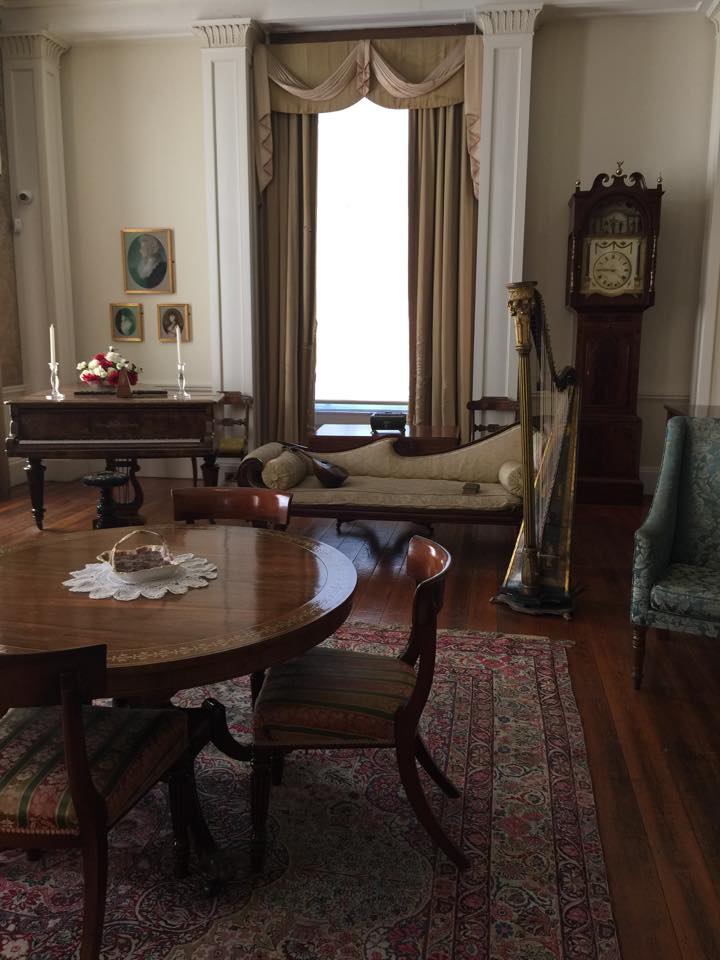
Historical Research: Inside a Manor House


Another blog post on my visit to Normanby Hall, in North Lincolnshire. 

My visit was for research to help write my historical novels, which usually include a manor house or two! It is wonderful to walk in the past's shoes. To see the furniture used in the days of my characters. I can feel the atmosphere in my mind and absorb vibe of the era, which I hopefully transfer into my stories.


 This photo I took half way down the driveway, from the rad to the village. You can just see the gate posts right at the end. The drive continues to go through an avenue of trees until it passes the stables, then the trees finish to open up in a park in front of the house, see photo above. 


The entrance hall of the house is square with rooms coming off to the right and the staircase to the left. The above photo is taken from the doorway leading into the drawing room, which is shown in photos below.


Beautiful silk wallpaper


 Modernisation comes to the Hall.


 The Dining Room


The Library


Architect's table


Next time, I'll blog about the upstairs.